
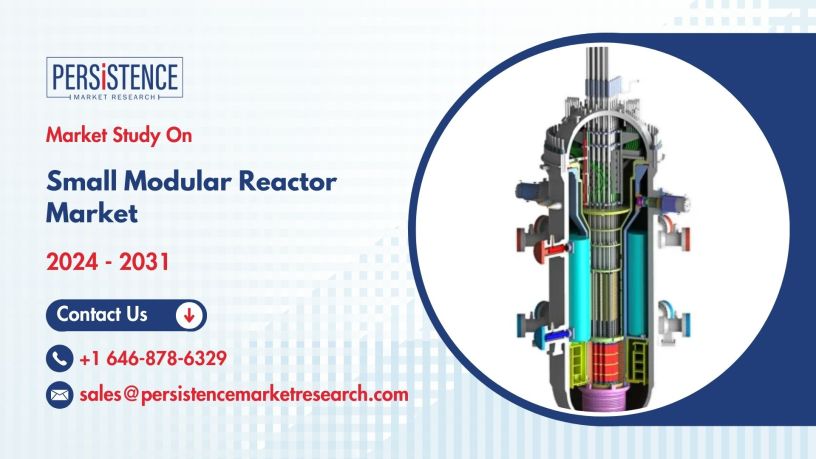
In the pursuit of cleaner, safer, and more efficient energy sources, small modular reactors (SMRs) have emerged as one of the most promising solutions for the future of nuclear power. These compact nuclear reactors, designed with modularity and scalability in mind, are increasingly attracting global attention due to their potential to revolutionize energy generation. From improved safety measures to cost-effectiveness and flexibility, SMRs are poised to play a key role in the global energy transition.
According to Persistence Market Research’s projections, the small modular reactor market is estimated to increase from US$ 5.1 billion in 2024 to US$ 9.5 billion by 2031. This reflects a compelling compound annual growth rate (CAGR) of 9.1% during the forecast period from 2024 to 2031, underscoring the sector’s rapid expansion and the increasing demand for innovative nuclear solutions.
Understanding the Appeal of Small Modular Reactors
SMRs differ from conventional nuclear reactors in size, construction, and deployment. Traditional nuclear power plants are large-scale, capital-intensive projects with complex infrastructures and long development timelines. In contrast, SMRs offer a compact design that enables them to be factory-built and shipped to sites for installation. This modular construction not only lowers upfront costs but also significantly reduces construction time.
The appeal of SMRs lies in their versatility. They can be used for electricity generation, district heating, water desalination, and even hydrogen production. Their small size and enhanced safety features make them ideal for remote locations, off-grid communities, and industrial sites, where traditional nuclear power would be impractical or uneconomical.
Technological Advancements Driving Market Growth
A key driver of the SMR market’s growth is the ongoing wave of technological innovation. Advances in reactor design, fuel technology, and passive safety systems are reshaping the way nuclear energy is produced and consumed.
Modern SMRs incorporate passive safety mechanisms that require no human intervention or external power to shut down safely in the event of an emergency. These designs reduce the risk of accidents and boost public and governmental confidence in nuclear technology.
Furthermore, developments in advanced fuels, such as TRISO (tristructural-isotropic) fuel, offer higher temperature tolerance and reduced risk of meltdown, making SMRs more robust and efficient. Many new reactor models are designed to use low-enriched uranium (LEU), which mitigates proliferation concerns and makes fuel sourcing more flexible.
In addition, digital technologies such as AI, machine learning, and remote monitoring are being integrated into SMR operations to optimize performance, enhance predictive maintenance, and reduce operational costs.
Global Policy Support and Funding
Government policies and international cooperation are playing a critical role in accelerating the SMR market. Countries such as the United States, Canada, the United Kingdom, Russia, and China are investing heavily in SMR research and development, offering financial incentives, and establishing regulatory frameworks to streamline deployment.
In the United States, the Department of Energy (DOE) has launched programs like the Advanced Reactor Demonstration Program (ARDP) to support the construction and demonstration of advanced nuclear reactors, including SMRs. Similarly, Canada is positioning itself as a global SMR hub through its SMR Roadmap, emphasizing collaboration with indigenous communities and other provinces for sustainable deployment.
Internationally, partnerships such as the Nuclear Energy Agency’s Small Modular Reactor initiative and the International Atomic Energy Agency’s (IAEA) Coordinated Research Projects are facilitating global collaboration, knowledge sharing, and standardization.
Applications Across Multiple Sectors
One of the most exciting aspects of SMRs is their wide range of potential applications beyond traditional electricity generation.
- Industrial Power Supply: Energy-intensive industries such as mining, steel production, and chemicals can benefit from SMRs as a stable, carbon-free energy source. Their ability to operate independently from the grid ensures a reliable power supply in even the most remote locations.
- Desalination Plants: In regions facing water scarcity, SMRs can be deployed to power desalination facilities, offering a sustainable solution to freshwater shortages without increasing carbon emissions.
- Hydrogen Production: With growing interest in the hydrogen economy, SMRs offer a low-carbon method of producing hydrogen through high-temperature electrolysis or thermochemical processes, helping decarbonize transport and industrial sectors.
- District Heating: In cold-climate regions, SMRs can serve as a source of heat for urban residential areas through district heating networks, replacing fossil-fuel-based systems.
Challenges and Roadblocks
Despite their potential, the SMR industry still faces several challenges. High initial capital costs, although lower than traditional nuclear plants, can still deter investors. The absence of fully operational, commercially deployed SMRs also raises concerns about economic feasibility and scalability.
Another major obstacle is regulatory uncertainty. Given that SMRs represent a new class of nuclear technology, existing nuclear regulations may not always be applicable. Licensing and approval processes can be complex and time-consuming, especially in countries with stringent nuclear oversight.
Public perception also remains a hurdle. While SMRs are designed to be safer than conventional reactors, the historical stigma associated with nuclear energy lingers. Transparent communication, education campaigns, and stakeholder engagement are vital to gaining public trust.
The Road Ahead: What to Expect by 2031
Looking ahead, the outlook for the SMR market is undeniably strong. As more demonstration projects succeed and regulatory pathways become clearer, commercial deployment is expected to accelerate. New entrants, startups, and strategic partnerships are also injecting fresh momentum into the industry.
According to Persistence Market Research, with the market projected to reach US$ 9.5 billion by 2031, we can expect a wave of new project announcements, public-private partnerships, and global investments. The 9.1% CAGR reflects not just market optimism but a tangible shift toward incorporating SMRs into national energy strategies.
Nations aiming to meet their net-zero goals are increasingly turning to SMRs as a clean, dependable energy source. In a world grappling with climate change, energy security, and geopolitical tensions, SMRs offer a compelling middle ground between sustainability and reliability.
Final Thoughts
The small modular reactor market is no longer a distant dream—it is a fast-evolving reality. With rapid technological progress, supportive policy frameworks, and increasing global demand for clean energy, SMRs are poised to reshape the nuclear energy landscape.
Their ability to offer scalable, safe, and flexible power solutions across diverse sectors positions them as a key component of the future energy mix. As we move toward a decarbonized world, the role of small modular reactors will only grow more significant.
For investors, energy planners, and policymakers, the time to engage with SMR technology is now—because the future of energy just might be smaller, smarter, and more modular than we ever imagined.
